Discovering Electronics
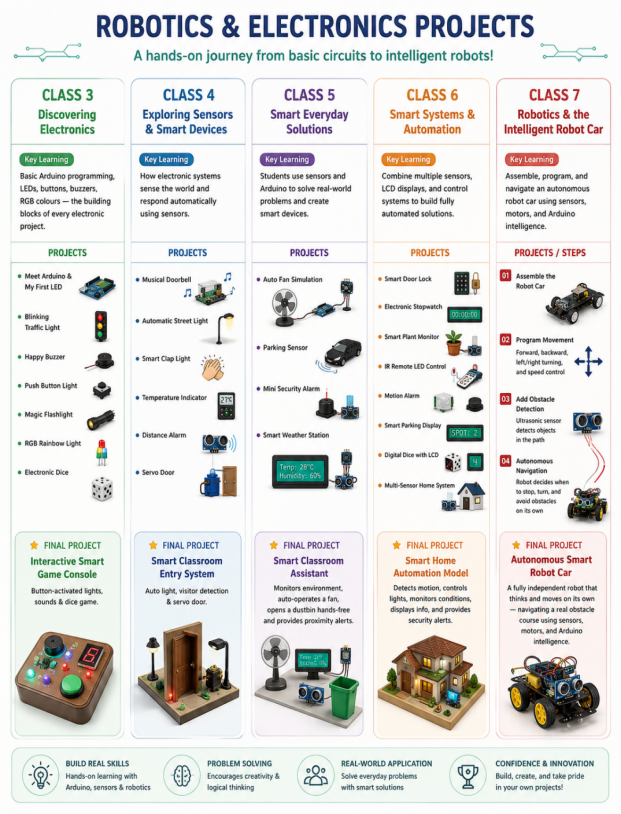
Basic Arduino programming, LEDs, buttons, buzzers, RGB colours and simple electronic outputs.
8 projects
Interactive project portfolio // Classes 3–7
A cinematic, hands-on journey through electronics, sensors, automation and autonomous robotics — transformed into an interactive digital experience.
Learning architecture
Each level builds on the last: basic electronic outputs → responsive sensors → smart devices → automated systems → autonomous robots.
Basic Arduino programming, LEDs, buttons, buzzers, RGB colours and simple electronic outputs.
8 projectsHow electronic systems sense the world and respond automatically using sensors.
7 projectsUse sensors and Arduino to solve real-world problems and create smart devices.
5 projectsCombine multiple sensors, LCD displays and control systems to build fully automated solutions.
9 projectsAssemble, program and navigate an autonomous robot car using sensors, motors and Arduino intelligence.
5 projectsThe projects
Showing 34 of 34 projects
Starter electronics. Build a first Arduino-controlled LED circuit and learn the basic idea of digital output.
Sequenced lights. Program red, yellow and green LEDs to blink in a timed traffic-light sequence.
Sound output. Create simple buzzer feedback and explore how code can control sound output.
Input + output. Use a push button as an input to switch a light on and off.
Interactive lighting. Create a simple interactive light that responds to a user action.
Colour mixing. Mix red, green and blue light to produce changing colours and rainbow effects.
Random output. Simulate a dice roll electronically using programmed random values and visual output.
Final integrated project. Combine button-activated lights, sounds and a dice game into one interactive console.
Sound interaction. Create a doorbell that plays a programmed tone or melody when activated.
Light sensing. Make a light that turns on automatically when surrounding light becomes low.
Sound sensing. Build a light that responds to a clap or a strong sound input.
Environmental sensing. Read temperature data and show a simple visual or numeric indication.
Proximity sensing. Detect a nearby object and trigger an alarm when it enters a set distance.
Motion control. Control a small model door using a servo motor and a simple trigger.
Final integrated project. Combine automatic lighting, visitor detection and a servo-controlled door into one classroom model.
Smart comfort. Simulate a fan that responds automatically to environmental conditions.
Distance feedback. Measure distance and provide increasingly urgent feedback as a vehicle approaches an obstacle.
Safety system. Create a compact alarm that detects a trigger and responds with an audible alert.
Data monitoring. Monitor simple weather data such as temperature and humidity and present it clearly.
Final integrated project. Monitor the environment, automate fan response, open a dustbin hands-free and provide proximity alerts.
Access control. Build a model door lock that responds to a programmed input or access code.
Time + display. Create a digital stopwatch with start, stop and reset interaction.
Plant care. Monitor plant conditions and provide a clear indication when attention is needed.
Remote control. Control lighting remotely using infrared signals.
Motion detection. Detect movement and activate an alarm response.
Parking guidance. Detect parking-space status and display a simple availability message.
Random + display. Generate a digital dice result and show the number on an LCD.
Connected automation. Combine several sensors to automate different functions in a model home.
Final integrated project. Build a smart-home model that detects motion, controls lights, monitors conditions, displays information and provides security alerts.
Robotics build. Assemble a working robot-car platform and understand its major electronic and mechanical parts.
Motor control. Program forward, backward, left and right movement with simple speed control.
Sensing. Use an ultrasonic sensor to detect objects in the robot car's path.
Decision making. Program the robot to decide when to stop, turn and avoid obstacles on its own.
Final integrated project. Create an independent robot that thinks, moves and navigates a real obstacle course using sensors and programmed decision-making.